
Inherited family identification: the psychological mechanism behind carrying what isn't yours

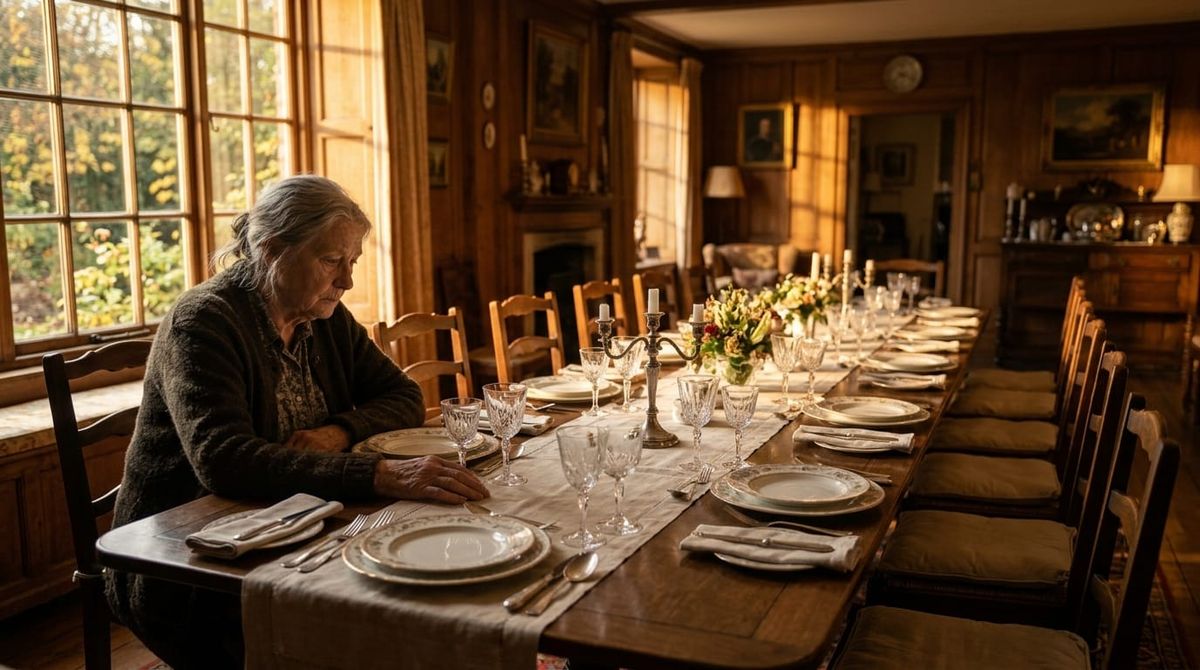
Identification is a psychological term that gets used loosely. In the context of family systems work, it has a specific meaning — and understanding that meaning is often the first moment a person recognises why they are living out patterns, fates, and emotional loads that were never theirs to carry in the first place.
Inherited family identification, in the psychological sense, is the process by which a descendant unconsciously takes on the emotional burden, relational pattern, or unlived life of an earlier family member — one who was excluded, unacknowledged, or unresolved within the family system. The crucial distinction from ordinary learned behaviour is this: the descendant has no conscious knowledge of the person they are carrying, and no learning channel through which the pattern could have been transmitted. It arrives as an internal imperative — a compulsion, a recurring circumstance, a grief or fear that cannot be located in the person's own history.
Inherited family identification occurs when a later family member unconsciously assumes the emotional burden, relational fate, or unlived life of an excluded or unacknowledged ancestor — not through learning or observation, but through the family system's drive toward completeness. It presents not as borrowed behaviour but as an internal imperative the carrier experiences as entirely their own.
The systemic family therapy foundation
The concept emerges with greatest clarity from systemic family constellation work — the tradition associated with Bert Hellinger and the broader field of family systems therapy. In this framework, family systems are not random collections of people; they operate according to implicit ordering principles, and they have a drive toward completeness. Every member of the system belongs to it, and when a member is excluded — through death without acknowledgement, through stigma or shame, through disinheritance, or through grief that was simply never processed — the system does not rest quietly with that absence. It generates a representative.
That representative is typically a later family member who unconsciously assumes the excluded person's emotional load, their relational patterns, or their unlived life. This is what systemic therapists mean when they speak of identification: not a choice, not a process the descendant is aware of, but a response from within the family field to an incompleteness that preceded their birth. The descendant's nervous system, relational patterns, and recurring life circumstances become shaped by a history they never consciously knew.
How identification differs from imitation
It is worth being precise here, because the conflation with imitation causes a great deal of confusion — both for clinicians and for the people who carry these patterns.
Imitation, or social learning, is conscious or semi-conscious modelling. A child watches a parent collapse under emotional weight and learns that relationships feel like drowning. An adolescent absorbs a family's attitude toward money, toward anger, toward intimacy, through years of proximity and observation. These are transmitted through a learning channel — through direct experience of the person and their behaviour, through emotional exposure over time. The descendant can, in principle, trace the learning back to its source.
Identification operates at an entirely different level. It is pre-conscious, somatic, and — critically — it functions in the absence of any relationship with the person being identified with. A person can identify with a great-grandparent who died before their parents were born, carrying that ancestor's specific grief or that ancestor's specific relational pattern, with no memory of the person and no possibility of having learned from them directly. There is no learning channel involved. The transmission does not require proximity, observation, or even knowledge that the person existed. This is what makes inherited identification so disorienting when it first surfaces in clinical work: the pattern fits perfectly the life of someone the carrier has never met.
The forms identification takes
Several recognisable forms appear consistently in this work, and naming them is useful because they tend to be described in ways that obscure what is actually happening.
The most common is living out a deceased ancestor's unlived life — the person who cannot fully settle, who is drawn toward a particular fate (emigration, relationship dissolution, a specific pattern of loss), mirroring what an ancestor experienced and never fully resolved. Less obviously, a descendant may carry a sibling's or child's excluded fate, particularly where infant death, elective termination, or other losses were never formally acknowledged in the family system. The unacknowledged loss does not dissolve; it finds a representative. A third form is completing a parent's unfinished emotional cycle — the child who spends their adult life attempting to resolve a grief the parent could not face, typically without any awareness that is what they are doing.
In each of these forms, the person experiences the identification not as inherited behaviour but as an internal imperative. It does not feel like imitation; it feels like character. That is precisely what makes it so persistent.
The moment of recognition
There is a particular moment I have seen in session work that I want to name directly, because it is where this understanding becomes personal rather than conceptual. A person is sitting with a grief they have carried since early adulthood — a grief that has no clear anchor in their own history, that feels too large for the events of their life, that surfaces most acutely on particular days or in particular relationships. They have spent years trying to locate its source in their own past. Then, in the course of working through their family system, they discover that a great-grandmother — a woman they were never told about, a woman whose name did not appear in family conversation — lost a child in silence during a period when such losses were not spoken of. The grief that this woman had no permission to grieve. That is the moment: when the specific quality of what they have been carrying — its texture, its weight, its particular flavour of longing — maps precisely onto a loss that belongs to someone who died before their grandparents were born. Not approximately. Precisely.
Identification as loyalty, not pathology
The reframe that changes the clinical picture most fundamentally is this: identification is not a failure of individuation. It is often presented as such — as a developmental arrest, as a failure to separate, as a sign that the person has not adequately differentiated their own identity. In my view, that is the wrong frame, and it generates the wrong treatment approach.
Identification is the family system's most fundamental loyalty mechanism. The later member's body and emotional architecture offer themselves as a vessel for the unresolved material of an earlier member — not from pathology but from belonging. The system drives toward completeness; identification is the vehicle. When I work with clients on this, the first shift that matters is not resolution of the pattern but recognition of its function: loyalty. The carrier is not broken; they are faithful to a system that asked something of them before they were old enough to have a say. Pathologising the identification — treating it as a symptom to be eliminated — misses what it is doing and why it persists. Honouring it as a loyalty is what creates the conditions for differentiation.
The resolution pathway
There are three stages to this work, and they do not collapse into one another.
The first is acknowledgement — identifying the inherited identification specifically enough to name who is being carried and what. Vague insight ("I think I carry family trauma") is not enough; the work requires sufficient specificity that the person can speak to the ancestor's actual situation, the actual exclusion, the actual burden. This specificity is not merely intellectual; it has a somatic quality, a settling in the body when the identification is named accurately.
The second stage is differentiation — formally separating the descendant's identity from the ancestor's unlived life or unresolved fate. This happens through ritual, through somatic work, through formal constellation process, or through the kind of direct dialogue with the ancestral field that characterises the shamanic lineage work I do alongside the clinical process. The form matters less than the quality of the act: the descendant speaks as themselves, to the ancestor, with enough authority to acknowledge the burden without continuing to carry it.
The third is release — and this is the stage most easily misunderstood. Release is not forgetting. It is not abandoning the ancestor. It is the nervous system updating its template from "I carry this as my own" to "I see this is yours; I lay it down with acknowledgement." This is not a single moment of breakthrough; it is a process with a direction, and the direction is toward the person's own life — their own grief, their own relational patterns, their own unlived life, rather than someone else's.
When you understand what inherited identification actually is, you stop trying to explain the pattern and start addressing it at the level where it lives. That is a different kind of work — and it has a different kind of result.
Your Lineage Ends Here. Your Healing Begins Now.
For broader context on ancestral trauma healing: the complete guide to ancestral trauma healing, patterns that are a lineage asking to be completed, carrying what was never yours, Dr Mark Demaine's work with family constellation and lineage resolution, how to break the loyalty pattern that underlies it, repeating your mother's relationship patterns, and the transmission mechanisms that make identification possible.
Dr Mark Demaine works with clients internationally. His doctoral research examined ancestral trauma transmission through epigenetic, psychological, and environmental pathways. He combines shamanic lineage work with somatic and breathwork practice. Read more about Mark.