Spiritual Awakening or Mental Health Problem? A Plain Guide to Telling the Difference
The two can look alike and can overlap, and no article can tell you which one you are living through. This guide sets out what people notice, a calmer way to think about it, and who to ask for what.

Dr Mark Demaine is a spiritual healing practitioner and ancestral trauma specialist.
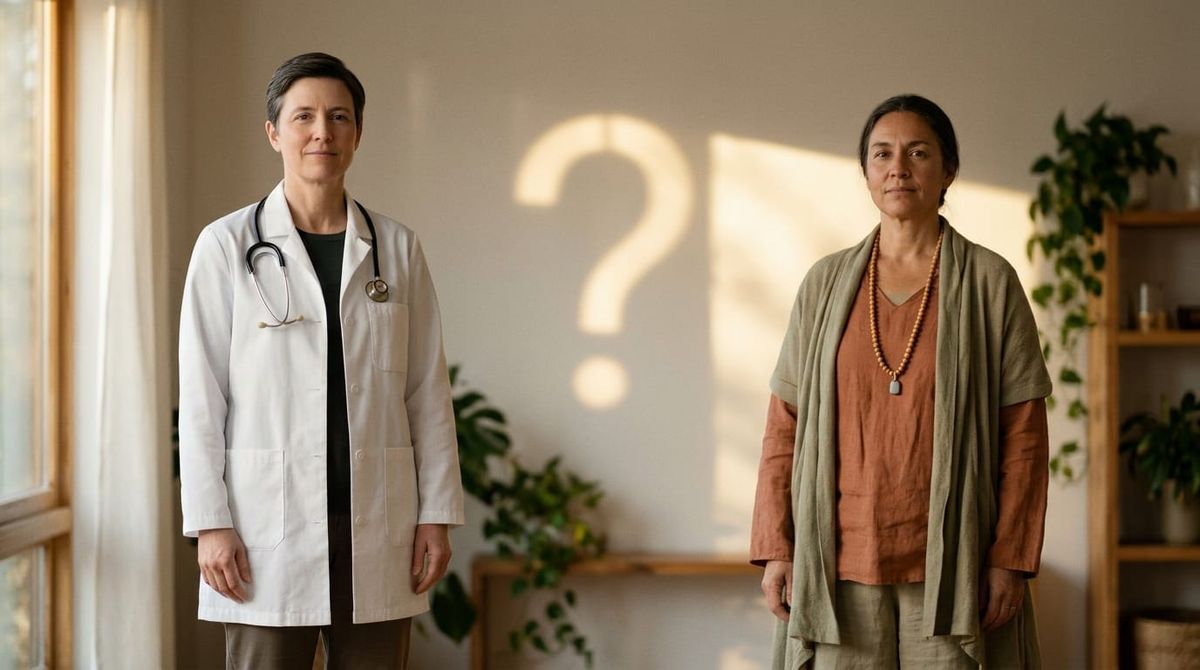
A spiritual awakening and a mental health problem can look alike and can happen together, and no article can tell you which you are living through. Both can bring broken sleep, strong feeling, unusual perceptions and a changed sense of self. A better first question than "which one?" is "what does this need from me now, and who can help?"
If you are reading this in the middle of something, take a breath first. You do not have to settle the question tonight.
For over two decades I have studied and worked with the experiences people call spiritual awakenings, and with the fear and loneliness that so often come with them. This guide is the longer, careful answer I would want a frightened person to find.
Is this a spiritual awakening or a mental health problem?
It can be either, or both, and the experience alone rarely tells you which. The two can look alike and can overlap. Both can bring sleeplessness, intense emotion, vivid or unusual perceptions, a shaken sense of self and a feeling that ordinary life no longer fits. What helps is looking at the whole picture over time.
Here is how it can sound. These are composite situations, not individual clients:
"Three weeks ago I had a night where everything felt connected and I cried with joy. Since then I sleep four hours, my mind will not stop, and I feel I have been shown something I must act on. My partner is frightened. I am not sure whether I am waking up or falling apart."
"After my father died I started seeing him in the corner of the room. I'm not afraid of it, but I keep wondering whether I should be. Is he lost? Is he trying to tell me something? How do I help him?"
"Since a retreat in the spring nothing feels solid. I'm losing interest in work, I don't recognise myself, and I can't tell if this is growth or depression with a spiritual label on it."
Each is asking a fair question, and each deserves a more careful answer than "it is definitely this" or "it is definitely that."
Why is it so hard to tell a spiritual awakening from a mental health problem?
Because the signs people use to tell them apart overlap. Intensity, odd perceptions and big meaning-making happen in spiritual opening, in severe stress, in grief, after trauma, and in some mental health conditions, including depression, anxiety and psychosis. One symptom proves very little. Direction, steadiness and context say more.
Language does not help. People in either kind of crisis reach for the same words: "energy", "presence", "a message", "I'm losing my mind". The body does not help either, because a nervous system under strain speeds up or shuts down whatever the trigger. And experiences can be layered. A moving spiritual moment can arrive while someone is exhausted, grieving, drinking heavily or already struggling with their mood.
So when someone talks to me, we talk about what is going on in their life and body, and who else is supporting them. A description on its own is not enough to go on.
What are the signs of a spiritual awakening, and what else can cause them?
Most people notice changes in sleep, feeling, perception, sense of self, relationships and body. These changes are common to spiritual awakenings and to several kinds of mental or physical strain. Noticing them tells you what you need. It is not a verdict on what you are.
These are the changes people describe to me most often:
- Sleep. Waking at the same hour every night, needing much less sleep, or dreams so vivid they feel like events. Sleep is where I start the conversation, because it affects everything else.
- Feeling. Waves of joy, grief or fear with no obvious story attached. Crying in odd places. Sudden tenderness towards strangers, or sudden irritation with people you love.
- Perception. Colours, sounds and textures seeming sharper. A sense of presence in the room. Watching yourself from slightly above or outside.
- Sense of self. Old identities, roles and goals losing their hold. "I don't know who I am any more" is one of the most common sentences I hear.
- Meaning. A strong feeling that everything is connected, or that you have been shown something. Sometimes a pull to explain it to everyone.
- Relationships. Friends who do not understand, a partner who is worried, and a growing feeling of being on your own with it.
- Body. Buzzing, tingling, heat, pressure in the head or chest, a stomach that will not settle. Or the opposite: heaviness and flatness.
None of this tells you which it is. What matters is how these changes behave over days and weeks, and what they do to the rest of your life.
What does the research say about spiritual experience and mental health?
Some have said for decades that spiritual experiences and mental health difficulties can overlap, and that the distinction matters. Careful work does not treat every unusual experience as an illness, and it does not treat every illness as a spiritual gift. Both mistakes cause harm.
I will keep to what I can cite, and say where I am giving a view and not a finding.
The psychologist David Lukoff described cases in which a mystical experience came with features that look psychotic. He argued that clinicians need a way to tell the two apart and to respect the person's spiritual framework while doing so. With colleagues he later helped to propose a diagnostic category for religious and spiritual problems. Sources: Lukoff, "The diagnosis of mystical experiences with psychotic features", Journal of Transpersonal Psychology, 1985; Lukoff, Lu and Turner, "Toward a more culturally sensitive DSM-IV: Psychoreligious and psychospiritual problems", Journal of Nervous and Mental Disease, 1992. The American Psychiatric Association's diagnostic manual (DSM-5-TR) includes a "Religious or Spiritual Problem" category (code Z65.8). It sits in the chapter on conditions that may be a focus of clinical attention, which lists problems that are not mental disorders in themselves.
Stanislav and Christina Grof used the term "spiritual emergency" for a crisis of personal transformation, and the collection they edited looks at how family, friends and professionals can help. Their term is not a medical one. I mention it because it names what many people feel: the same event can be both a breakthrough and a crisis. Source: Grof, S. and Grof, C. (eds), Spiritual Emergency: When Personal Transformation Becomes a Crisis, Tarcher, 1989.
Jackson and Fulford used three case histories to argue that unusual experiences of this kind cannot be told apart as spiritual or pathological by their form and content alone, and they pointed to how the experience affects the person's life and ability to function. Source: Jackson and Fulford, "Spiritual experience and psychopathology", Philosophy, Psychiatry, & Psychology, 4(1), 1997.
Unusual experiences are also more common than many people assume. In a study of 227 widows and 66 widowers in mid-Wales, almost half reported sensing, hearing or seeing their late spouse. Rees described these experiences as normal and often helpful accompaniments of widowhood. Source: Rees, "The hallucinations of widowhood", British Medical Journal, 1971.
Researchers who study meditation have documented difficult experiences too. A study led by Jared Lindahl interviewed Western Buddhist meditators about challenging experiences that arose from practice, including altered perception, strong emotion and changes in how the body feels. That study covers meditators, not every spiritual experience. Source: Lindahl et al., "The varieties of contemplative experience", PLOS ONE, 2017.
What I take from this is modest. Overlap is recognised. Spiritual experiences are not automatically symptoms. And a careful look at the whole person, over time, is the sensible way to tell what is happening.
How can I think about it without needing a verdict tonight?
Ask about direction, function, pressure and company, not about the label. Is it settling or climbing? Can you look after yourself? Is there urgency? Are you still in touch with people who know you?
This is my working view, drawn from practice and not from a trial. It is a set of questions, not a test, and it sits alongside the judgement of someone who can see you.
Is it settling or climbing? Are the strongest moments getting further apart and softer as the days go by, or closer together and louder? Settling can look like a wave that is easing. Climbing looks like each day needing more of you than the one before.
Can you still look after yourself? Eating, washing, sleeping some of the night, paying a bill, answering a message. When everyday care slips and keeps slipping, that is useful information, whatever the cause.
Is there pressure to act? Insight often arrives with a quiet sense of rightness and no deadline. A strong urgency to quit your job, give things away, confront someone or tell the world tonight is worth putting down and talking over with someone steady first. Big decisions can wait.
What is happening to your sleep? Sleeping fewer hours while feeling more energy, not less, with ideas coming faster than you can follow, deserves attention from a person who can assess you.
Are you still connected? Staying in touch with at least one person who knows you well is protective. An experience that pulls you steadily away from everyone, or makes you suspicious of those closest to you, calls for more support.
What else is going on? Recent loss, a break-up, a job change, illness, heavy alcohol, plant medicines, long retreats or medication changes. Context rarely explains an experience away, but it changes how much weight you give it.
Is it frightening? Awe and fear can sit together. If the fear is taking over, or the experience comes with thoughts that others are watching or controlling you, or voices telling you to hurt yourself or someone else, talk to someone who can assess you in person, that day.
None of these needs an answer tonight. They give you something to hold up against what is happening, and something to say to the people helping you.
Is spiritual awakening real, and is it dangerous?
People do report real, life-changing spiritual experiences, and I take them seriously. In my experience, much of the difficulty lies in what happens around the experience: too little sleep, too much intensity, isolation, and big decisions made too fast. Some experiences are frightening or unsafe in themselves, and those need someone who can see you in person.
Two points sit side by side here.
First, "spiritual awakening" is not a medical or scientific category, and science does not confirm it as a distinct event. Still, it is a fair description of something many people live through: a period in which old structures of identity and belief loosen and a different way of seeing opens. I treat people's accounts of it with respect, and with care.
Second, a loosened sense of self can be tender. A nervous system that is suddenly open can be flooded as easily as moved. That is why I put steadiness first: sleep, food, company and a daily rhythm. For practical steps after an intense experience, see how to stay grounded during a spiritual awakening.
Why do these experiences so often follow loss, stress or trauma?
Because a system under pressure tends to open, in the good sense and in the difficult sense. Loss, burnout, illness and old unresolved pain often come before a period of spiritual intensity. That does not make the experience less real. It means the body is usually part of the story.
Many people I speak to date it from something: a death, a break-up, a birth, a long stretch of holding everything together. Once they slow down, what they had been outrunning can catch up.
My working view, formed over two decades of inquiry and in my doctoral research, is that some of this may be generational trauma, the kind passed down through a family, surfacing as a person's system opens and quietens. This is my observation and my hypothesis, drawn from practice and from what clients tell me. It is not an established scientific finding. Researchers are studying whether stress and trauma can influence later generations through biological routes, and the most careful reviews describe the evidence in humans as still unsettled. Source: Yehuda, R. and Lehrner, A., "Intergenerational transmission of trauma effects: putative role of epigenetic mechanisms", World Psychiatry, 2018. Seeing what you feel as possibly part of a longer family story can take some of the fear out of it for some people. That is the only claim I make for the idea.
If you would like to explore that angle once you feel steady, the Ancestral Trauma Healing Guide covers generational trauma in full. The Somatic Healing Guide is a gentle place to begin if your experience is mostly in the body.
Who do people usually go to for what?
People go to different people for different things, and you can ask more than one. People usually go to a GP for sleep, mood, medication and physical causes. People often go to a counsellor or therapist for patterns, trauma, anxiety and low mood. People go to a spiritual healer or practitioner for meaning, language that fits the experience and company in it. People turn to a steady friend or family member for presence.
People usually go to a GP for sleep, mood, medication and physical causes. Thyroid, blood sugar, infections, hormonal changes and medication side effects can all produce strange states, and a medical check looks at parts of you that a spiritual lens cannot see. If you already have a diagnosis or take medication, speak to your doctor before changing anything.
People often go to a counsellor or therapist for patterns, trauma, anxiety and low mood. Many people work with them on relationships and patterns over weeks or months. It is fair to ask at the start how they would approach a spiritual experience, and to look for someone who takes your experience seriously without dismissing or inflating it.
People go to a spiritual healer or practitioner for meaning, language that fits the experience, body-based and energy-based practice, ceremony and company in it. A good one will slow you down, welcome your other care, and say plainly what they can and cannot help with. I have written more about how shamanic practice works alongside modern therapy.
People turn to a steady friend or family member for ten quiet minutes, a meal, a walk and a lift to an appointment. They do not need to understand. They need to stay.
You do not have to choose one. A common mistake is believing you must pick a camp: spiritual or medical. Many people find it works well to bring the pieces together, tell each helper about the others, and let each do their own job. My sessions are designed to sit alongside any care you have from a doctor or therapist.
Whoever you choose, look for someone who asks about your sleep, health and support before they talk about meaning, who is comfortable with "I don't know yet", and who leaves you steadier and more yourself, not more reliant on their reading of you. Be cautious of anyone who is certain within minutes, promises an outcome, or discourages you from seeing anyone else. This applies to guides and clinicians alike, and you are allowed to look for a better fit.
What helps whichever it turns out to be?
The basics help in nearly every case. They are sleep, a gentle daily rhythm, easing off anything that adds intensity, holding big decisions until you have been sleeping well for a while, and staying in touch with people. If you take medication or anything else that affects you, a doctor or pharmacist can advise. The step-by-step version is in how to stay grounded during a spiritual awakening.
How I work with this
I listen, ground and work with what you bring, alongside whatever care you already have. What I offer is company, a calm pace and body-based, lineage-based practice for the emotional patterns people want to understand once they feel steady.
People often come to me with a question nobody around them can hold. I stay steady with them. We look at sleep, rhythm and support first. When there is steadiness, we look at what the experience has stirred up, including old and inherited patterns, starting from the body. I listen to what you are living and help you find the right mix of support.
My book Somatic Healing for the Soul sets out the body-based side of this work in more depth.
Would it help to talk it through?
If you would like to talk it through with someone who will take it at your pace, you can book a free Discovery Call. There is no commitment. We can talk about what you are experiencing and whether my sessions might fit alongside the support you already have.
Frequently asked questions
Can I have a spiritual awakening and a mental health condition at the same time?
Yes. The two can overlap, and one can make the other harder to see. That is why it helps to bring in different kinds of support and let each do its own job. No page can judge your case, and I look at the whole picture with the person over time.
How do I know if it is a spiritual awakening or a breakdown?
Look at direction and function over days and weeks. Is it settling or climbing? Are you eating and sleeping? Is there pressure to act? Are you still in touch with people who know you? These questions point to the kind of support you need. They do not give a label.
Is spiritual awakening real?
People do report real, life-changing spiritual experiences, and I take them seriously. "Spiritual awakening" is not a medical or scientific category, and science does not confirm it as a distinct event. It is a fair description of a period when old ideas of who you are loosen.
Is spiritual awakening dangerous?
In my experience the trouble often comes from sleeplessness, extra intensity, isolation and hurried decisions, which is why I put steadiness first. Some experiences are frightening or unsafe in themselves. If you feel unsafe or are frightened by what you are experiencing, speak to someone who can see you in person.
Should I see a therapist or a spiritual healer?
You do not have to choose. People usually go to a therapist for patterns, trauma and anxiety, and to a spiritual healer for meaning, language and company in the experience. Many people use both and tell each about the other. Choose people who welcome your other support and keep the pace yours.
Why does it often start after loss or a hard time?
Pressure, grief and exhaustion tend to loosen a person's usual defences, and what has been held back can rise. That does not make the experience less real. It does mean sleep, food and support come first. I explore the possible family-history side in my ancestral trauma guide.
Dr Mark Demaine is a spiritual healing practitioner and ancestral trauma specialist. He is the founder of Soul Journey Wisdom and author of Somatic Healing for the Soul, and holds a Ph.D in Philosophy specialising in Ancestral Trauma and an M.MSc in Metaphysical Science.