
Why the body heals differently outdoors — and what the science actually shows
There is a particular quality of quiet that arrives about twenty minutes into a walk through old woodland. Not silence — the woods are rarely…

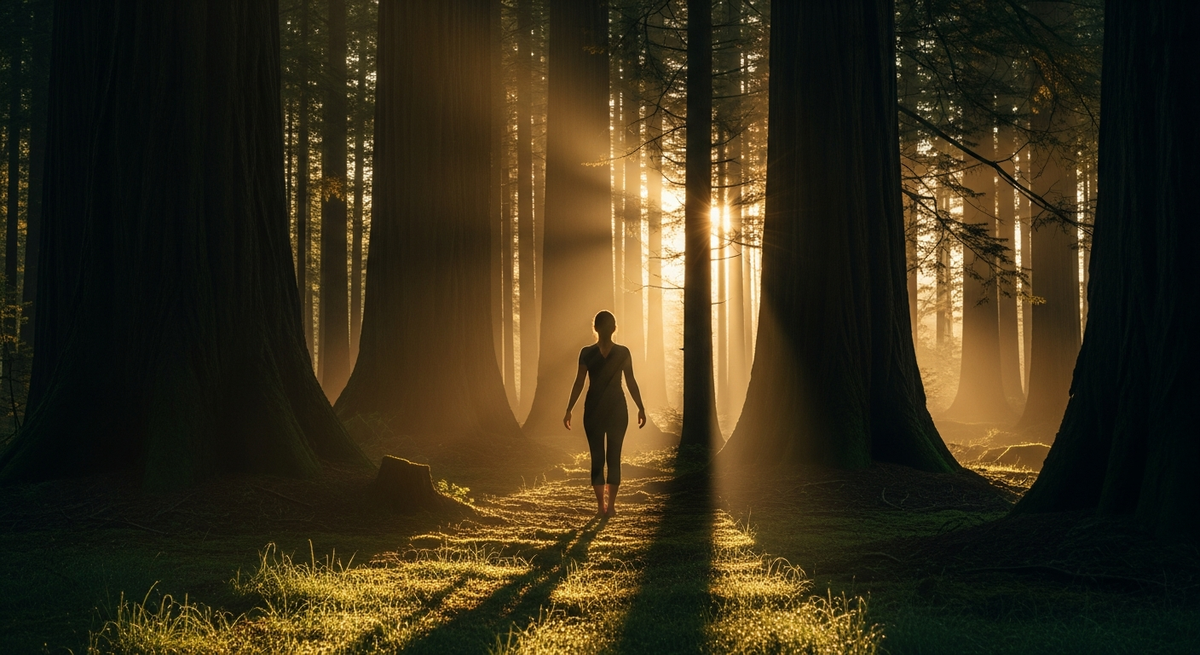
There is a particular quality of quiet that arrives about twenty minutes into a walk through old woodland. Not silence — the woods are rarely silent — but a different kind of listening. The body stops scanning. The shoulders, which most people carry near their ears without knowing it, drop by half an inch. The jaw unclenches. Something that was running in the background, continuously, without being named, goes quiet.
I have noticed this in myself over decades of practice, and I have watched it happen in clients who would describe themselves as entirely non-spiritual and who came to this not for the mysticism but for the biology. They are not disappointed.
What the nervous system does in natural environments is measurably different from what it does in built ones. The attentional demands of urban settings — visual complexity, acoustic load, navigational pressure — maintain a mild but continuous state of activation that the system rarely fully discharges. Natural environments, by contrast, engage what environmental psychologists call involuntary attention: the kind that arises without effort and does not deplete the regulatory resources that vigilance demands. The result is a physiological shift that is not placebo. It is a documented change in the body's stress architecture.
Healing through nature's energy is not metaphorical. The mechanisms are specific, the research is replicable, and the effects are available to anyone willing to change where they spend their time.
What the body actually receives — in measurable terms
Time in nature resets nervous system patterns that reflect our ancestral inheritance — the body responding to environments in which our lineage spent the vast majority of human history. Epigenetic markers of chronic stress may be responsive to sustained time in natural settings, offering a somatic pathway that addresses inherited dysregulation at a biological level.
The physiological evidence has accumulated substantially, and the numbers are striking enough that they deserve stating plainly.
Research on forest bathing — the Japanese practice of Shinrin-Yoku, studied extensively by Qing Li and colleagues at Nippon Medical School — documents significant increases in natural killer cell activity following forest immersion, alongside reductions in cortisol, adrenaline, and noradrenaline that persist for days after the exposure. A two-day forest visit was shown to increase NK cell activity by more than fifty per cent and maintain that elevation for a month. A month, from two days of walking slowly through trees. That number tends to land differently when people really sit with it.
Physical contact with natural surfaces — bare skin contact with soil, grass, or water — produces reductions in cortisol and inflammatory markers. The body carries a positive electrical charge when chronically disconnected from the earth's surface; ground contact normalises this through electron transfer, with measurable effects on cortisol rhythm and inflammatory cytokine levels. This is the mechanism behind what practitioners across traditions have described as grounding, and it is not folkloric. It is biochemistry.
Sunlight exposure activates serotonin synthesis and regulates the hypothalamic-pituitary-adrenal axis that governs the stress response cycle. Morning sunlight is particularly significant because it anchors circadian rhythm — the regulatory foundation upon which all other recovery depends. Most people in the developed world are chronically under-exposed to morning light and chronically over-exposed to evening artificial light, and this pattern alone is sufficient to destabilise the stress architecture that everything else depends on.
The practices — and what each one is specifically doing
Connecting with nature's healing capacity supports wellbeing through a cluster of measurable physiological effects — reduced cortisol, enhanced parasympathetic activation, increased NK cell activity, and the somatic discharge that physical contact with natural surfaces produces. These are not all the same thing, and they are addressed by different practices.
Earthing is the simplest: bare feet on grass, soil, or sand for a minimum of twenty minutes, ideally in the morning when cortisol is naturally peaking. The combination of ground contact and early daylight exposure addresses both the circadian and inflammatory baselines simultaneously. The barrier to this practice is entirely psychological. The investment is nothing.
Forest bathing is not hiking. This distinction matters. It is slow, sensory immersion in a natural environment — walking without a destination, attending to what is visible, audible, and scented without the need to process or evaluate. The practice interrupts the verbal-analytical mode that most people sustain continuously and allows the body's autonomic regulation to proceed without cognitive interference. Even thirty minutes produces measurable cortisol reduction; ninety minutes or more produces the immune effects that Li's research documents. The goal is not exercise, not distance covered, not improvement. Just presence in a body that has stopped performing.
Proximity to natural water — sitting by a river, lake, or coastline — reliably produces the parasympathetic shift that urban environments prevent. The acoustic quality of moving water occupies the attentional system involuntarily, and the negative ion concentration of coastal and riparian environments appears to contribute additional physiological benefit. The mechanism is less thoroughly studied than the forest literature, but the phenomenological evidence across cultures is consistent enough to take seriously.
Therapeutic gardening engages the body in slow, purposeful physical work with natural materials — soil, root systems, seasonal growth — and produces the combination of mild physical activity, sensory grounding, and extended present-moment focus that other practices replicate but cannot quite match for somatic completeness. There is also something about the relationship with something living and growing, tended over time, that provides a particular quality of regulatory anchor. The garden asks nothing dramatic. It asks for consistent attention. And in providing it, something in the person providing it also settles.
If what you're reading here is prompting something — if there is a quality of depletion or activation in your system that hasn't responded to the usual approaches — a free 20-minute conversation is worth considering. Not to add another protocol to your life, but to understand what your nervous system is actually asking for. Book that here.
Sunlight practice — sitting outdoors in morning light with eyes open and skin exposed, even for fifteen minutes — is one of the highest-leverage daily habits for mood and stress regulation. The combination of circadian anchoring, serotonin activation, and the mild warmth of early sun is directly regulatory. It requires nothing other than access to an outdoor space and the decision to use it before the screen.
The threshold for benefit is lower than you think
The barrier most people construct is one of access and time. Neither obstacle is as significant as assumed. Consistent brief exposures — a morning walk in a park, a work break taken outside rather than at a screen, an evening spent in outdoor light — produce cumulative effects on the body's stress baseline that occasional long excursions cannot replicate on their own.
Nature does not require special access or elaborate preparation. It requires regularity. The body's recovery systems respond to what the environment provides consistently, not to what it provides occasionally. This is, in one sense, simply how biological systems work: they adapt to the conditions they reliably encounter, not the conditions they encounter once. The corollary for most people in modern environments is that the body has adapted to a chronic absence of what it actually needs. The good news is that adaptation works in both directions.
The piece I wrote on energy clearing techniques covers some of the same physiological ground from a different angle — specifically what accumulates in the body and the immediate environment, and the practices that address it directly. The two approaches are complementary: nature provides the regulatory baseline; clearing practices address what sits on top of it.
Your Lineage Ends Here. Your Healing Begins Now.
When did you last spend twenty minutes outdoors without a phone, without a purpose, without needing to be somewhere next? What did that feel like — or what stopped it from happening?
Dr Mark Demaine works with clients internationally. His doctoral research examined ancestral trauma transmission through epigenetic, psychological, and environmental pathways. He combines shamanic lineage work with somatic and breathwork practice. Read more about Mark.
The somatic mechanisms described here — how the nervous system shifts when environmental demands change — are the same mechanisms engaged in structured somatic healing practice. The Somatic Healing for the Soul guide sets out how to work with these regulatory responses deliberately, indoors or out.
When the nervous system dysregulation that outdoor environments temporarily ease has ancestral roots — a calibration inherited rather than personally acquired — the ancestral trauma healing guide explains how that transmission works and what it takes to reach it.
