
Why You Can "Know Better" and Still React the Same Way
Knowing your patterns intellectually doesn't change how you react under stress, because your reactions live somewhere your thinking brain can't reach.


The gap between intellectual understanding and physiological response — knowing what you should feel or do whilst the body continues to react differently — is explained by the architecture of the nervous system, which processes threat and activates survival responses stored in the body before the prefrontal cortex has access to the situation. Joseph LeDoux's research on the amygdala and fear pathways demonstrates that subcortical stress responses can initiate in milliseconds, faster than conscious thought can intervene; this means that insight alone is categorically insufficient to change a deeply embedded, inherited pattern held in the body. Lasting healing and change requires working at the somatic, embodied level (including with stored, inherited patterns from the family of origin) — with the body's regulatory system directly — not only at the level of understanding.
You know what you should do when the difficult moment arrives. You've read the books, done the therapy, had the breakthroughs that genuinely changed how you understand yourself. You can explain your patterns to other people with perfect clarity, and you can recognise them in yourself when you look back at past situations. You genuinely want to respond differently the next time.
And then the next time arrives — a critique from someone whose opinion matters to you, a rejection that lands harder than it should, a financial stressor that throws your whole sense of safety into question — and you do the exact same thing you've always done. You shut down, lash out, freeze, or fall into people-pleasing habits that you swore you'd left behind years ago.
If any of this sounds familiar, you aren't broken and you haven't failed. What's actually happening here isn't about a lack of willpower or insight. It's about where your reactions are actually stored in the first place, and that's a layer that conscious knowledge alone simply cannot reach.
Your nervous system doesn't care what you know
The part of your brain that holds your insights and understanding is not the same part that controls how you react under stress. They're different systems entirely, with different jobs and different operating speeds, and they don't always communicate well with one another.
Your prefrontal cortex is what you might call the wise adult in your brain. It's brilliant at analysis, planning, reflection, and sense-making. It's where your intellectual insights live, where your understanding of your own habits is held, and where your good intentions are formed. When you read a book about your attachment style or have a breakthrough in therapy, this is the part of your brain that's doing the integrating.
Your amygdala, by contrast, is something more like the frightened child or the protective guardian within you. When you feel threatened in any way, this much older survival centre takes the steering wheel of your responses, and it does so faster than your conscious mind can register what's happening. The amygdala doesn't have access to your therapy breakthroughs or your hard-won insights. It's running on much older, much faster programming designed for one purpose only — keeping you alive in the face of perceived threat.
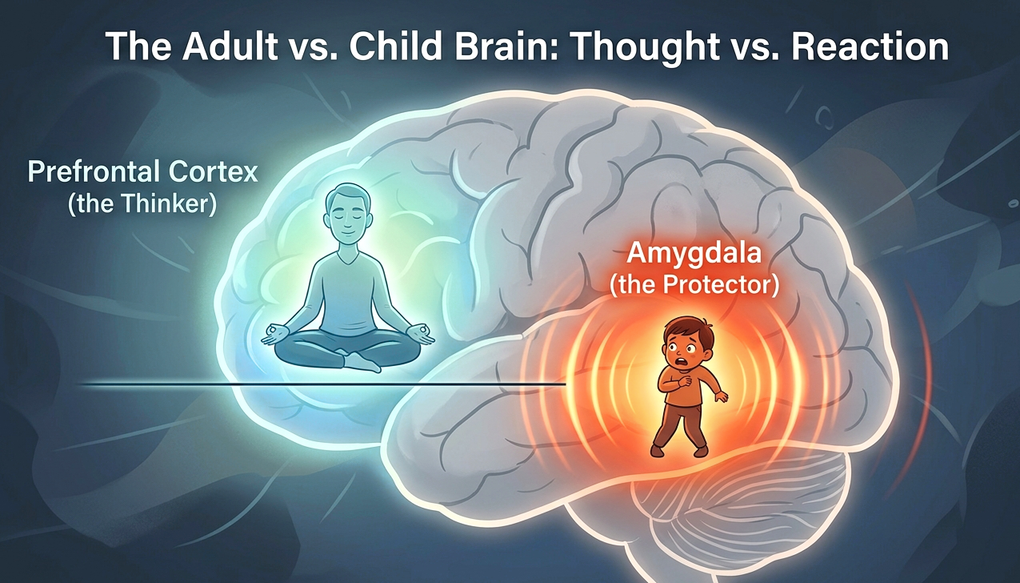
Stored reactions live in the body, not the mind
Your habitual reactions aren't really thoughts at all. They're physical responses stored as what's called implicit memory or somatic memory. When you experienced past overwhelm, your system learned a strategy that worked at the time to keep you safe. Becoming small. Going quiet. Becoming hypervigilant. Pleasing whoever was upset. Fighting back. Disappearing emotionally.
These survival strategies are stored in your muscle memory, in your breathing rhythm, in your gut responses, and in the way your shoulders rise toward your ears when something feels off. From an energy healing perspective, these holding patterns also create contractions in your energy field that reinforce the physical responses, creating a loop that keeps the same reaction readily available whenever something similar arises.
The speed of thought versus the speed of reaction
There's a timing problem at the heart of all this that's worth understanding clearly. Stored responses happen in milliseconds, far faster than conscious thought can move. By the time you've consciously registered what's happening in front of you, your body is already flooded with stress hormones and your reaction is already underway. You're trying to catch a train that left the station several seconds ago, and no amount of running after it is going to change that fact in the moment.
This is why insight alone, however genuine and well-earned, often fails to change how you actually behave under stress. It's not that the insight is wrong or that you don't really mean it. It's that understanding lives in a part of you that simply isn't fast enough to be in charge when the protective systems take over.
Why ancestral material is even harder to shift
If you're carrying emotional material that originated not in your own life but in your family's history, the wiring goes even deeper than your personal biography. Epigenetics has shown that an ancestor's survival states — a grandmother's terror during wartime, a father's freeze response from his own childhood, a great-grandparent's grief that never had room to be processed — can be passed down through the generations and continue to shape the nervous systems of descendants who never personally experienced those events.
You might find yourself reacting to threats your body remembers even though you yourself have never encountered them. You're not overreacting to what's actually happening in front of you. Your nervous system is responding to very old information from generations back, which feels just as immediate and real as any threat you've encountered personally. The body doesn't distinguish between what was yours originally and what was inherited — it simply holds the imprint and runs the response when something triggers it.
Closing the gap: what your body actually needs
Trying to change an embodied reaction with conscious thought alone is a bit like trying to change the direction of a river by thinking very hard about it from the bank. The river — your nervous system — needs more direct intervention than that.
For real change to happen at this layer, your nervous system needs new experiences rather than just new information. The kinds of work that genuinely reach this layer include:
Breathwork, which can help complete and release stored stress that has been held in the body for years. Somatic practices, which teach your system new ways of feeling safe in the world rather than only thinking about safety abstractly. Energy work, which addresses what's stored in your energetic field and the contractions that have built up around the protective responses. And co-regulation, which is the felt safety of another regulated person's presence helping your nervous system find a different state than the one it's habituated to.
None of this replaces the value of insight. But understanding without embodied work tends to leave you knowing exactly what's happening while still being unable to do anything about it in the moments that matter.
Trusting the process of catching yourself earlier
Change at this level happens in layers, often more gradually than we'd like. You might not stop the reaction entirely for a long time, and you don't need to for change to be real. What you may begin to notice instead is that you catch yourself earlier than you used to.
Where you used to argue for twenty minutes before realising what was happening, you now notice the cycle after five. Where you used to shut down for days at a time, you find yourself recovering in one. The window between trigger and reaction slowly widens, and that window — small at first, then larger — is where your choice gradually starts to live.
 These small shifts are real shifts, even when they feel frustratingly slow.
Being gentle with yourself in the meantime
Reacting the same way despite knowing better isn't a moral failing or a sign that you haven't progressed. Your frustration with yourself only adds fuel to the underlying stress response, making the whole thing harder rather than easier. Compassion does the opposite. Something as simple as the internal sentence "my nervous system is trying to protect me with outdated information, and it means well even when its strategies don't work anymore" can begin to soften the cycle of reaction and self-criticism that often follows.
Trusting the longer arc
Change at the nervous system level happens slowly, and in layers that aren't always visible while they're happening. You might not react differently for quite a while, but you might notice yourself recovering more quickly than you used to. Or feeling less shame about a reaction afterwards. Or understanding more clearly what triggered it and where it came from.
These are all signs that something is shifting beneath the surface, even when the surface still looks the same. Your nervous system is gradually learning that it has options beyond the old stored responses, and that learning takes time to settle into the body where the reactions actually live.
Trust that process, even when it feels frustratingly slow. The understanding you've already developed isn't wasted. It's the beginning of the journey rather than the destination, and the deeper work that addresses the body and the inherited layers can take that understanding and give it somewhere to land.
If your reactions seem to come from somewhere older than your own life, the work I describe in Ancestral Healing addresses inherited patterns at their actual source — in the body and the lineage rather than only in conscious understanding. To explore whether this work fits your situation, you can book a free Discovery Call — thirty minutes, no commitment, just an honest conversation about what you're carrying and whether what I offer might genuinely help.
Your Lineage Ends Here. Your Healing Begins Now.
Related reading
- Ancestral Trauma Healing: A Complete Guide
- Emotional Patterns That Don't Belong to the Present Moment
- Moving Memory from Mind to Body: Somatic Approaches to Inherited Trauma
When this pattern doesn't shift even with years of therapy, the reason is usually that verbal approaches don't reach the body-level storage.
One underexplored reason reactions persist: the nervous system can't distinguish imagination from reality, so it rehearses the same response.
